

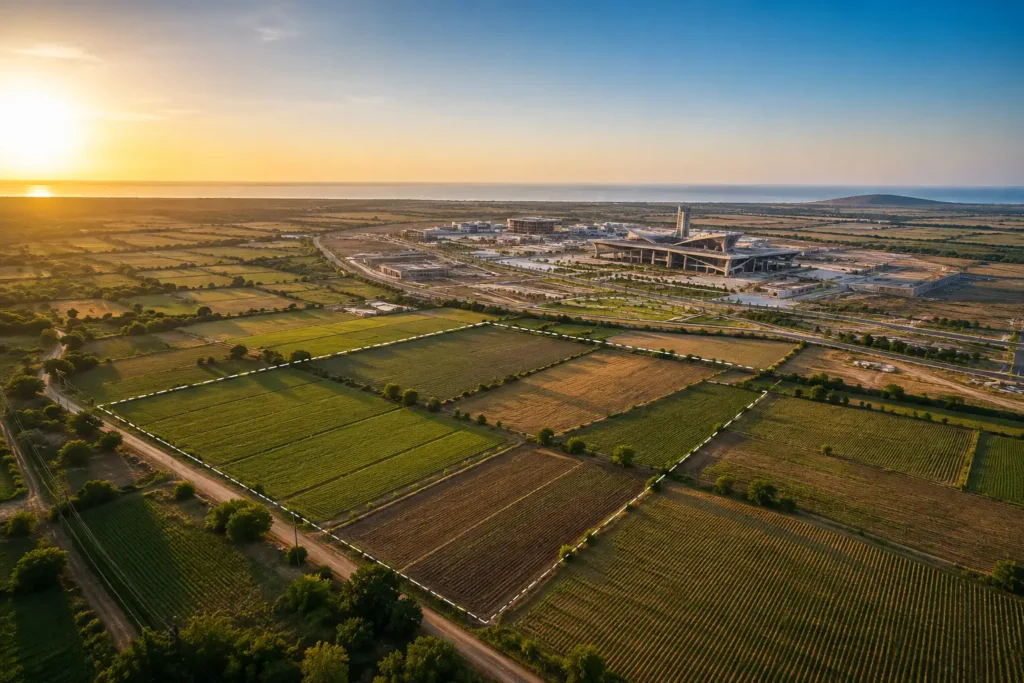
Bulk land in Lothal is agricultural land sold by the acre, usually assembled from several survey numbers with different owners. Phase 1A of the National Maritime Heritage Complex alone carries a sanctioned cost of ₹1,238.05 crore. Before buying, settle three things: the purchase route, the co-owner list, and the ceiling limit. August 2026.
Introduction
You are not buying a plot. You are buying seven survey numbers, each with a different family on the 7/12, and one of those families has a brother in Dubai who has not signed anything.
That is the real shape of a bulk land deal near Lothal, and no listing page describes it. The pitch stops at “50 acres available near NMHC” and leaves you to discover the rest at the Sub-Registrar’s office.
This article covers the three things that decide whether a Lothal bulk deal closes: which legal route lets you buy at all, how much you are allowed to hold, and how to verify an aggregated parcel before money moves.
Key Takeaways
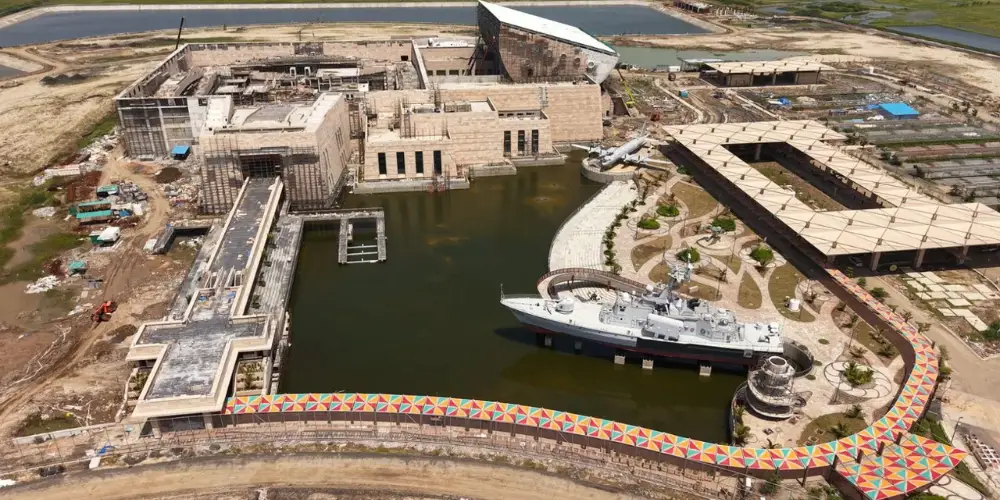
- NMHC Phase 1A carries a sanctioned cost of ₹1,238.05 crore, funded through Major Ports, the Ministry of Defence and the Ministry of Culture.
- Phase 2 includes a hospitality zone with maritime-themed eco-resorts and a Museuotel — the single most relevant fact for bulk buyers targeting hotel or resort land.
- A separate lighthouse museum, planned as the tallest in the world, carries a projected ₹266.11 crore cost funded by the DGLL.
- 1 acre = 4,840 sq yards = 40 guntha. The Gujarat vigha is not a fixed unit and varies by district — never accept a price quoted in vigha without conversion.
- Under Section 63AA of Gujarat’s tenancy law, a company may purchase agricultural land for a bona fide industrial purpose without prior permission, subject to intimation and commencement conditions.
- Gujarat’s agricultural land ceiling law caps how much agricultural land one holder may own. Bulk buyers routinely hit this limit and must structure accordingly.
What counts as bulk land in Lothal?
There is no legal definition. In practice, brokers in this belt use “bulk” for anything above roughly 5 acres, and institutional deals start around 25 acres.
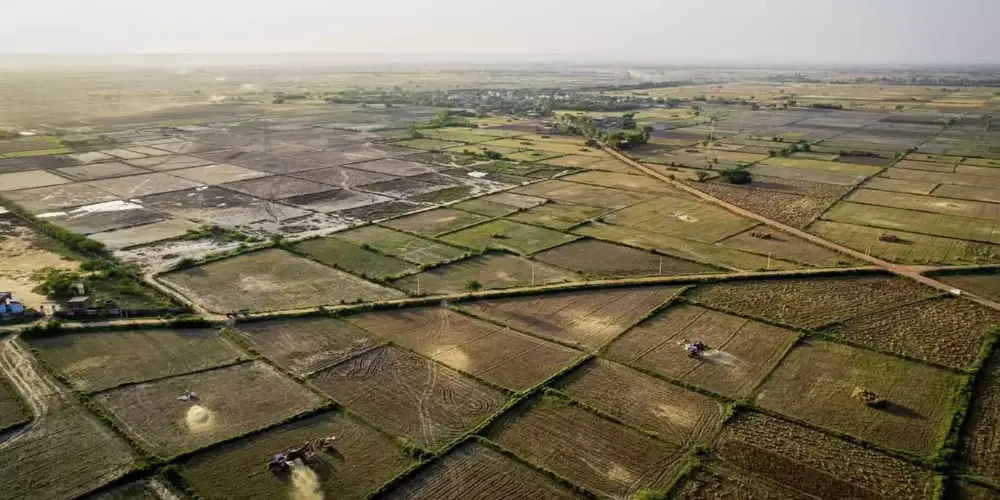
The distinction that matters is not size, it is assembly. A 40-acre parcel in Lothal is almost never one owner and one survey number. It is a stitched-together set of holdings, and the seller you are speaking to may control only some of them through unregistered agreements with the rest.
Ask one question early: is this a single-owner parcel or an aggregated one? Everything downstream — timeline, price, risk — changes with the answer.
What is the price of bulk land in Lothal per acre?
We publish no rate we have not seen on a registered document. Bulk pricing in this belt moves on three variables: road frontage, whether the parcel touches a metalled road at all, and how many owners must be paid.
A useful discipline: ask for the rate per acre, then convert it yourself to per square yard, then compare that against retail plot rates nearby. If the bulk rate is not meaningfully below the retail plot rate, you are paying a developer’s margin without receiving a developed layout.
All prices are indicative and vary by parcel, road access, ownership structure and legal status.
How do you convert acres, guntha, vigha and hectares?
Sellers switch units mid-negotiation, sometimes deliberately. Fix the maths before you talk price.
| Unit | Equals | Notes |
| 1 acre | 4,840 sq yards | The standard bulk unit |
| 1 acre | 43,560 sq ft | 1 sq yard = 9 sq ft |
| 1 acre | 40 guntha | 1 guntha = 121 sq yards |
| 1 hectare | 2.471 acres | Revenue records often use hectares |
| 1 hectare | 10,000 sq metres | As recorded on the 7/12 |
| 1 vigha (Gujarat) | Not fixed | Varies by district and custom — always demand the acre or hectare figure |
The 7/12 extract states area in hectares and ares. If a seller’s acre figure does not reconcile with the 7/12 hectare figure, stop and find out why before proceeding.
Can a company buy agricultural land in Gujarat?

This is the question that decides most bulk deals, and the answer is more open than people assume.
Gujarat’s tenancy legislation generally bars a non-agriculturist from buying agricultural land. But Section 63AA creates a route: a person or company may purchase agricultural land for a bona fide industrial purpose without obtaining prior permission, provided the statutory conditions are met — typically intimation to the Collector within a prescribed window and commencement of the purpose within a prescribed period, failing which the purchase can be disturbed.
| Route | Who it suits | Key condition |
| Purchase as an agriculturist | Buyers already holding agricultural land in India | Must prove agriculturist status |
| Section 63AA — bona fide industrial purpose | Companies, industrial and warehousing buyers | Intimation to Collector; must commence the purpose within the prescribed period |
| Purchase after NA conversion | Residential, commercial and hospitality buyers | NA order must state the permitted use you actually intend |
| Collector’s permission under Section 63 | Case-by-case buyers | Discretionary; slower |
Two warnings. First, an NA order granted for residential use does not permit a hotel. Match the order to your intended use before you sign, not afterwards. Second, the bona fide industrial route is not a loophole for holding land idle — the commencement condition is enforceable.
Take written advice from a Gujarat revenue advocate on which route applies to your entity. This section is orientation, not legal advice.
Is there a limit on how much agricultural land you can hold?
Yes. Gujarat’s agricultural land ceiling legislation sets a maximum holding per person, varying by whether the land is irrigated, seasonally irrigated or dry.
Bulk buyers hit this constantly. Holdings are typically structured across entities or acquired post-conversion to stay compliant. What you must not do is exceed the ceiling and hope nobody checks — surplus land can be declared and vested, and the buyer bears that loss.
There is a second, quieter restriction. Gujarat’s fragmentation and consolidation law prevents agricultural holdings from being split below a notified minimum area for the local block. If your plan involves subdividing an agricultural parcel before conversion, check this first.
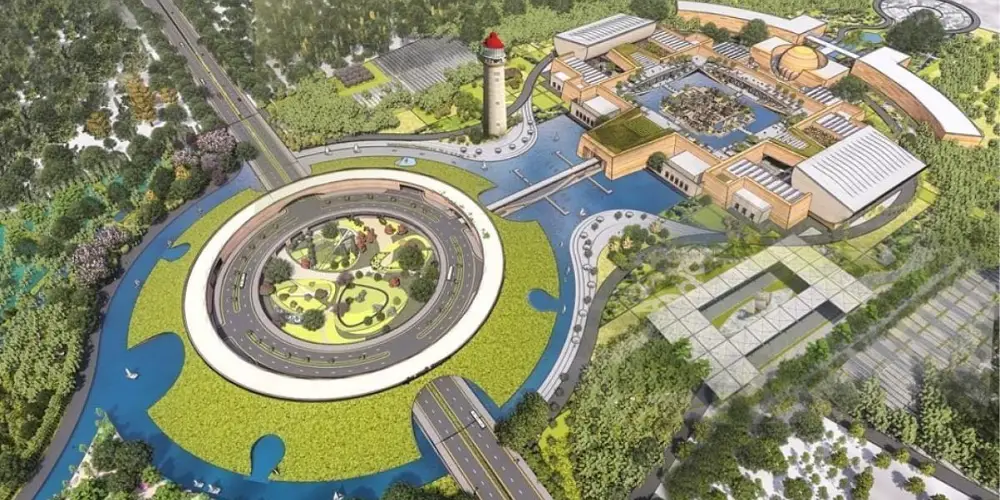
What is being built at Lothal, and which phase matters for bulk buyers?
| Phase | Contents | Sanctioned cost |
| Phase 1A | Museum galleries, model of the ancient Lothal township, open aquatic gallery, jetty walkway | ₹1,238.05 crore — Major Ports, Ministry of Defence, Ministry of Culture |
| Phase 1B | Eight additional galleries; lighthouse museum, planned as the world’s tallest; Bagicha complex with parking for ~1,500 vehicles, food hall, medical centre | Lighthouse museum ₹266.11 crore — DGLL |
| Phase 2 | Coastal States Pavilions; hospitality zone with maritime-themed eco-resorts and a Museuotel; recreation of ancient Lothal |
For a bulk buyer, Phase 2 is the whole thesis. Parking for 1,500 vehicles and a planned hospitality zone tell you the government expects visitor volumes that a village cannot absorb. That gap — rooms, food, coach parking, staff housing — is what land near the approach road exists to fill.
It also tells you the use case. Bulk land near Lothal is a hospitality and services play, not an industrial one. Industrial buyers are better served by the notified industrial zones inside Dholera SIR, where trunk infrastructure already exists.
How do you verify an aggregated parcel before paying?
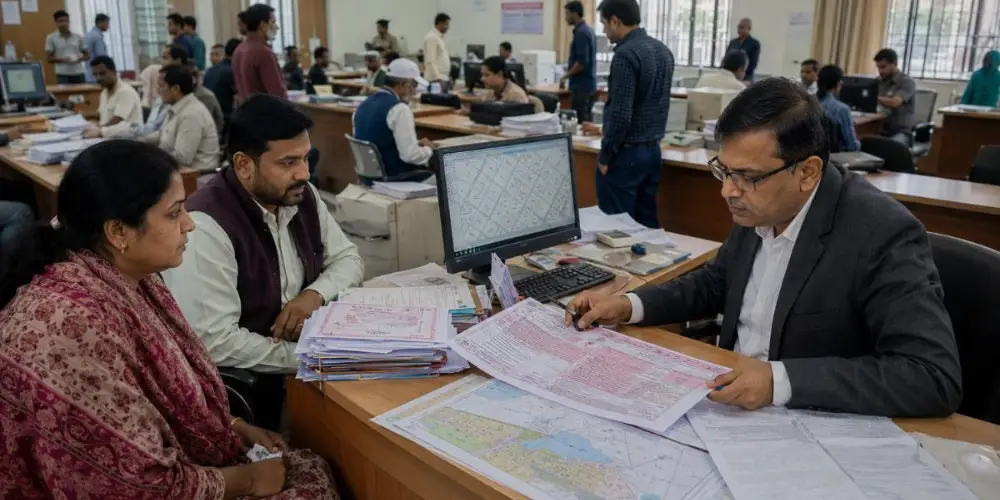
Single-plot diligence does not scale to bulk. Run this per survey number, not per parcel.
| Check | Why it matters in a bulk deal |
| 7/12 and 8-A for every survey number | One clean survey number does not clear the others |
| Full co-owner list, including minors and heirs abroad | A single unsigned co-owner blocks registration of the whole parcel |
| 30-year encumbrance search per survey number | Old mortgages sit on individual holdings, not on the assembled parcel |
| Boundary demarcation by a licensed surveyor | Aggregated parcels frequently have gaps and overlaps between holdings |
| Kabja — who is physically in possession | Paper title and actual possession diverge more often on farmland |
| Access — is there a legal right of way to a public road? | A landlocked parcel is worth a fraction of a fronted one |
| Distance from ASI protected limits | Land within 300 m of the monument carries construction restrictions |
| Tribal / restricted tenure entries (new tenure land) | Some holdings cannot be transferred without permission at all |
On the ASI point: Lothal is a centrally protected monument. Construction is prohibited within 100 metres of the protected limits and regulated for the next 200 metres. If any part of your parcel falls in that band, that portion cannot carry buildings. Map it before you price it.
Do not accept a single “master” title report covering the whole parcel. Insist on the chain, survey number by survey number.
What we tell bulk buyers who ask about Lothal

Where Lothal bulk land wins: it is a tourism-anchored hospitality play with a defined government catalyst, at entry pricing well below developed-city land.
Where Dholera SIR bulk land wins: layouts sit inside notified Town Planning schemes with allotted final plot numbers, trunk infrastructure is built in the Activation Area, and the Gujarat Budget 2026 allocated ₹610 crore to Dholera infrastructure. For a buyer who needs a sanctioning authority, a TP number and a defensible exit, that certainty is worth paying for.
Our bulk land desk covers Dholera SIR parcels for industrial, warehousing and township use, alongside our plotted projects — Angel Palm Dholera in Kamiyala village, roughly five minutes from the Ahmedabad–Dholera Expressway, and Angel Aerocity near the airport corridor.
Send us the survey numbers of any Lothal parcel you are evaluating. We will tell you the tenure class, ceiling exposure and ASI position before you spend money on diligence.
What can go wrong in a Lothal bulk deal
Be clear-eyed about all six.
Aggregation failure. The most common outcome. Five owners sign, two do not, and the parcel you priced no longer exists in that shape.
Unregistered control. A seller “controlling” land through a satakhat or power of attorney does not own it. Only a registered sale deed transfers title.
Ceiling breach. Exceeding the agricultural ceiling can result in surplus land being declared and vested. Structure before you buy, not after.
Wrong NA use. An NA order for residential use will not support a resort. Conversion for the correct use takes time you may not have budgeted.
ASI restriction. Any portion within 300 metres of the protected monument carries construction limits regardless of what you paid.
Timing. Lothal’s value depends on visitor footfall that has not yet arrived at scale. Bulk land is illiquid, and resale buyers for large agricultural parcels are few. Budget for a long hold.
Lothal is not outside Dholera SIR by accident — it is a separate revenue village under a different planning authority. Anyone describing Lothal bulk land as “Dholera Smart City land” is either careless or selling you something.
Conclusion
Three facts should govern a Lothal bulk decision.
First, the government catalyst is real and funded — ₹1,238.05 crore sanctioned for Phase 1A alone, with a hospitality zone planned in Phase 2. The demand thesis has a documented basis.
Second, almost every bulk parcel here is an aggregation. Your diligence runs per survey number, your timeline runs to months not weeks, and one unsigned co-owner can end the deal.
Third, the purchase route and the ceiling limit must be settled before you negotiate price. Agriculturist status, Section 63AA, or NA conversion — pick the right one for your entity and your intended use, in writing.
Get those three right and Lothal is a defensible long-hold. Get them wrong and the price was never the problem.
Talk to our bulk land desk
Send the survey numbers you are evaluating and we will return a written note on tenure class, ceiling exposure, ASI position and access — before you commission full diligence.
WhatsApp: +91 9266337671 — ask for the bulk land desk Free download: Angel Nova Bulk Land Due Diligence Checklist + Dholera TP Zone Map (PDF) Site visit: We walk both the Lothal approach road and available Dholera SIR parcels in one day, with revenue records in hand.
Angel Nova Group
Frequently Asked Questions
It depends on use. A boutique guesthouse works on 1–2 acres; a resort with parking and back-of-house typically needs 5 acres or more. Below roughly 5 acres you lose the price advantage of buying bulk while still carrying agricultural-land complications. Decide the use first, then size the parcel to it.
No. An NRI or OCI holder cannot acquire agricultural land, plantation property or farmhouses in India under FEMA, regardless of size. NRIs typically participate after NA conversion is complete, or through an Indian company using the bona fide industrial route. Take FEMA advice before structuring anything.
Single-owner parcels with clean title can register in four to eight weeks. Aggregated parcels commonly take four to nine months, because every co-owner must be traced, agreed and physically present or represented at registration. NA conversion adds further time on top.
Gujarat levies stamp duty and a registration fee on the higher of the transaction value or the jantri value. On a bulk parcel this is a material line item, so model it before you agree a price.
No. Large agricultural parcels have a small buyer pool, and aggregated parcels are harder still because a new buyer must re-verify every survey number. Liquidity improves substantially once the land is NA converted with clear title and road frontage. Plan a multi-year hold rather than a trade.