

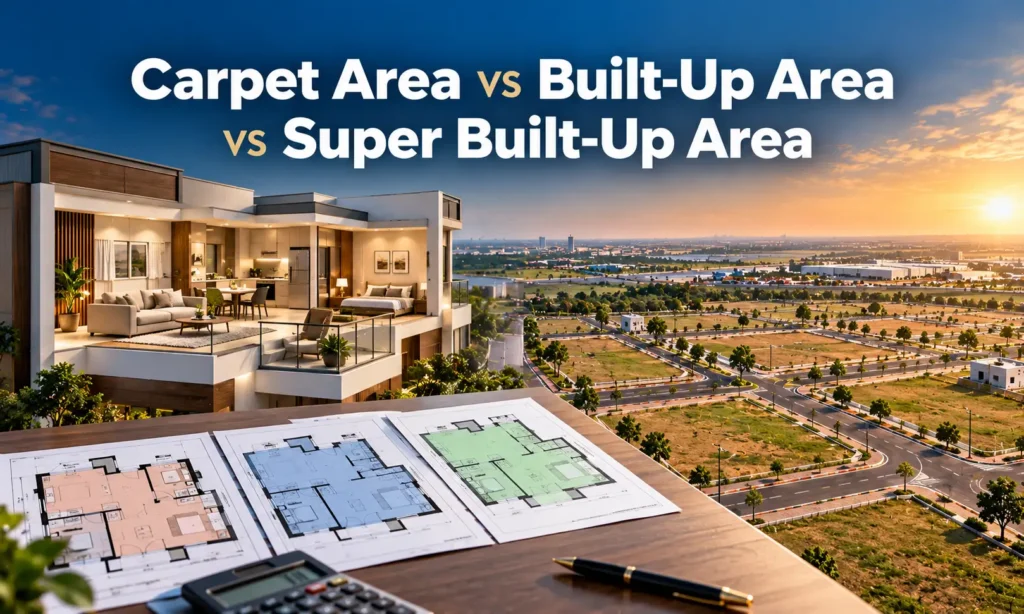
Property terms can confuse even experienced investors. Carpet area, built-up area and super built-up area show up in almost every real estate brochure.
But here is the catch. These three terms are meant for flats and buildings. They do not describe an open plot of land.
If you are looking at land in Dholera, the number that really matters is different. It is the verified final plot area under the relevant Town Planning (TP) scheme.
This guide breaks down all three terms, explains where they apply, and shows what plot buyers should check instead.
1. Carpet Area: The Only Legally Defined Measure
Carpet area is the actual usable floor space inside an apartment. It is the area where you can lay a carpet, walk around and place furniture.
It is the only one of the three terms with a legal definition. Section 2(k) of the Real Estate (Regulation and Development) Act, 2016 (RERA) defines it.
What carpet area includes:
- Usable floor space of all rooms
- Area under internal partition walls
What carpet area excludes:
- External walls
- Service shafts
- Exclusive balconies or verandahs
- Exclusive open terraces
Because it is clearly defined, carpet area is the most reliable figure for comparing two apartments.
2. Built-Up Area: Carpet Area Plus Walls
Built-up area takes the carpet area and adds the space occupied by walls.
In common market practice, many developers also add exclusive balconies to this figure. That is where the confusion starts.
Built-up area has no single legal definition. One project may include balconies, another may not. So the same flat could show different built-up figures depending on who calculates it.
Simple way to remember it: Built-up area = Carpet area + wall area (+ balcony, in many projects)
When you see a built-up figure, always ask what exactly has been counted.
3. Super Built-Up Area: Adding Your Share of Common Spaces
Super built-up area goes one step further. It takes the built-up area and adds a proportionate share of the building’s common areas.
Common areas usually include:
- Lobbies and entrance halls
- Staircases and lift shafts
- Corridors
- Shared amenities
The gap between super built-up area and carpet area is known as “loading.” A higher loading means you pay for more space that you cannot use privately.
This is why super built-up area often looks impressive on paper. The real living space can be much smaller.
4. How RERA Changed the Rules for Buyers

RERA brought clarity to apartment sales by making carpet area the reference measure.
Key RERA points to know:
- Promoters of registered projects must disclose the carpet area of each unit.
- Apartment sales are expected to be priced and agreed on a carpet-area basis.
- This stops buyers from paying flat rates on inflated super built-up figures.
What about plotted projects? Plotted developments are generally exempt from RERA registration if:
- The land is 500 sq m or less, or
- The project has eight units or fewer.
Larger plotted projects in Dholera that are registered can be checked on the GujRERA portal. It is a quick, free step that every buyer should take.
5. Why These Terms Don’t Fit Open Plots in Dholera
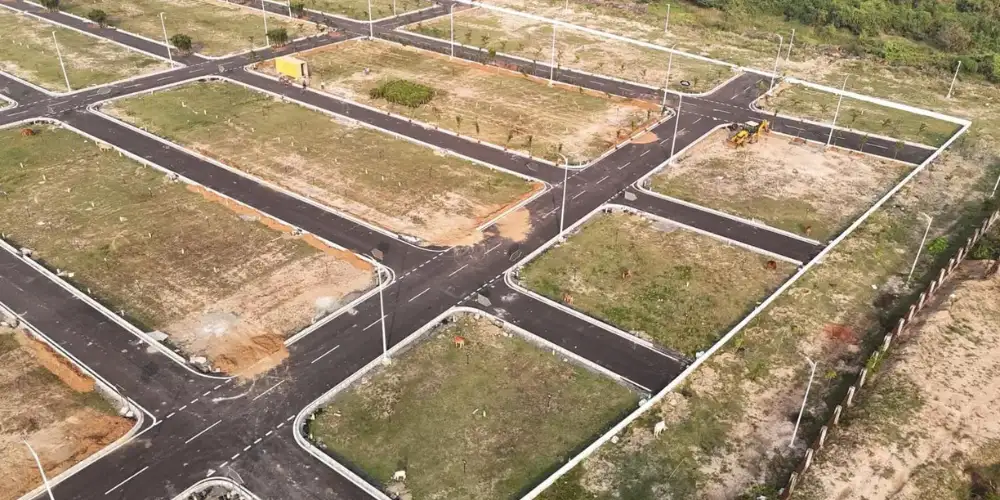
An open plot has no walls, no lobbies and no lift shafts. So carpet, built-up and super built-up area simply do not apply.
If a seller uses apartment-style terms for a plot, treat it as a red flag. Ask for the exact plot area shown in official documents.
How plots are measured locally:
- Plots are usually measured in square yards, locally called “var.”
- 1 sq yd = 9 sq ft
- 1 sq yd ≈ 0.836 sq m
Some documents record area in square metres or square feet. Convert everything into one unit before comparing deals.
6. Original Plot vs Final Plot: The Number That Really Matters
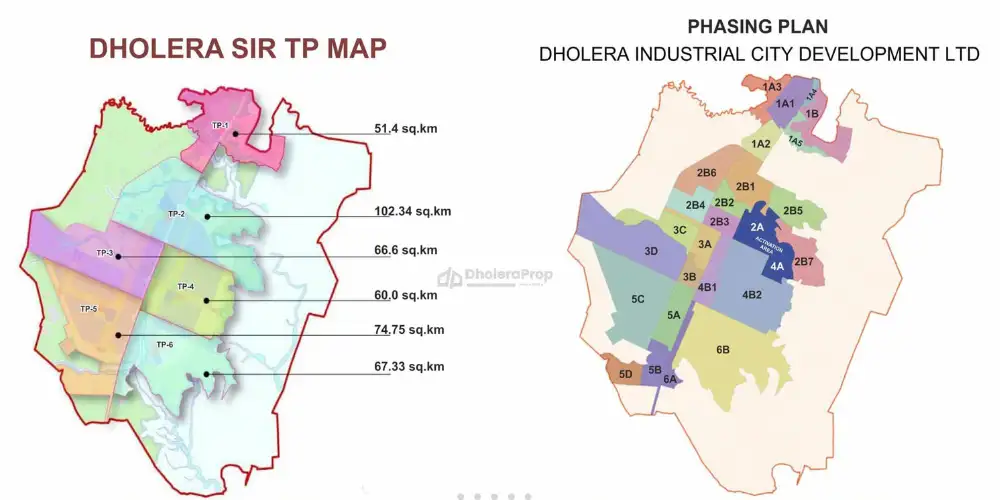
Dholera Special Investment Region (SIR) is being developed through TP schemes under the Gujarat Town Planning and Urban Development Act, 1976.
How a TP scheme works:
- Land parcels in an area are pooled together.
- The land is reorganised into a planned layout.
- Portions are set aside for roads, utilities and public amenities.
- Owners receive reconstituted “final plots.”
Because land goes towards public infrastructure, the final plot can be smaller than the original holding. Official statements have indicated deductions of up to 50% in exchange for developed infrastructure.
This means older survey records may show a far bigger area than what is finally allotted. Buying on the original figure could leave you paying for land you will never own.
7. Smart Pricing and Verification Checklist for Plot Buyers
A low per-square-yard rate can be misleading. Here is how to see the real price.
Step 1: Ask which area the rate is based on Is the quoted price per sq yd for the original survey area or the final plot area?
Step 2: Work out the effective rate Divide the total price by the final plot area. This gives the true cost per sq yd and lets you compare plots fairly.
Step 3: Verify key details from official records
- TP scheme number
- Final plot number
- Final plot area
Step 4: Get an independent check Have all documents reviewed by an independent legal expert before you pay anything.
Planning to build later? How much you can construct on a plot depends on the applicable development control regulations. These set the permissible built-up area for your plot. Check them before you finalise any construction plans.
Quick Comparison Table
| Measure | Applies To | Legally Defined? | What It Includes |
| Carpet Area | Flats / buildings | Yes (RERA Sec 2(k)) | Usable floor + internal partition walls |
| Built-Up Area | Flats / buildings | No | Carpet area + walls (often balconies) |
| Super Built-Up Area | Flats / buildings | No | Built-up area + share of common areas |
| Final Plot Area | Open plots (TP schemes) | Yes, via TP records | Allotted land after scheme deductions |
Final Thoughts
Carpet, built-up and super built-up area are useful when buying an apartment. For land, they are the wrong yardstick.
When investing in a Dholera plot, focus on the final plot area, the TP scheme details and the effective price per square yard. Verify everything from official records, and you will avoid most costly surprises.
Frequently Asked Questions
Carpet area is the private usable space inside a flat. Super built-up area adds walls and a share of common areas like lobbies and lifts.
No. Only carpet area has a legal definition under RERA. Built-up area calculations can vary from project to project.
Loading is the difference between super built-up area and carpet area. It shows how much non-private space is added to your unit.
No. These terms are for flats and buildings. For plots, check the verified final plot area under the TP scheme.
“Var” is the local term for a square yard. One var equals 9 sq ft, or about 0.836 sq m.