

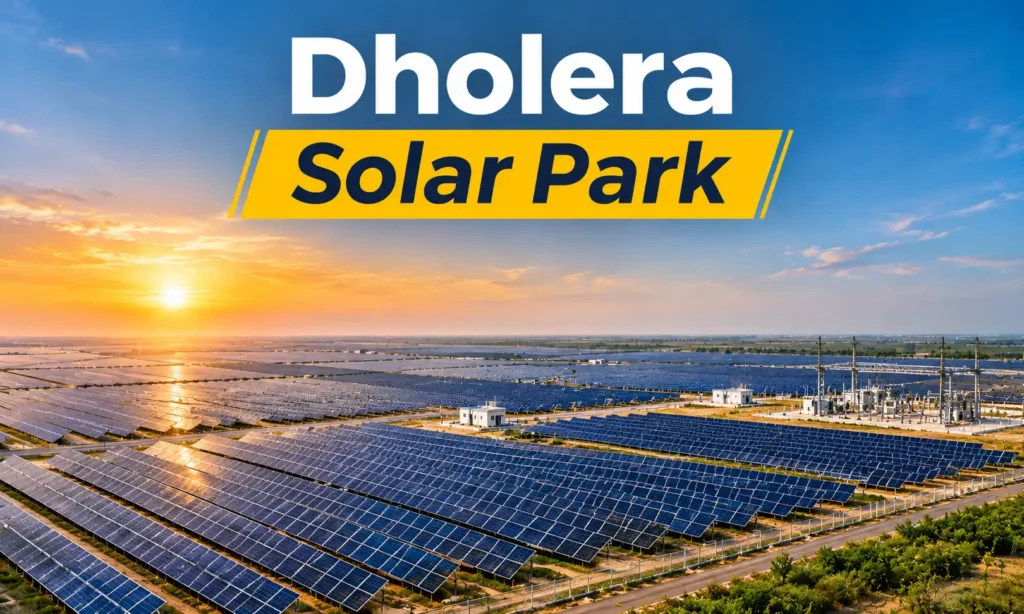
The Dholera Solar Park is one of the biggest energy projects planned for Gujarat. It sits inside the Dholera Special Investment Region (DSIR), the same region that is being built as India’s greenfield smart city.
For anyone following Dholera, the park is more than a power project. It shows how energy, industry and urban planning are being developed side by side.
In this guide, Angel Nova Group explains what the Dholera Solar Park is, where it stands today, the technology it uses, the challenges it has faced and what it could mean for the wider region.
What Is the Dholera Solar Park?
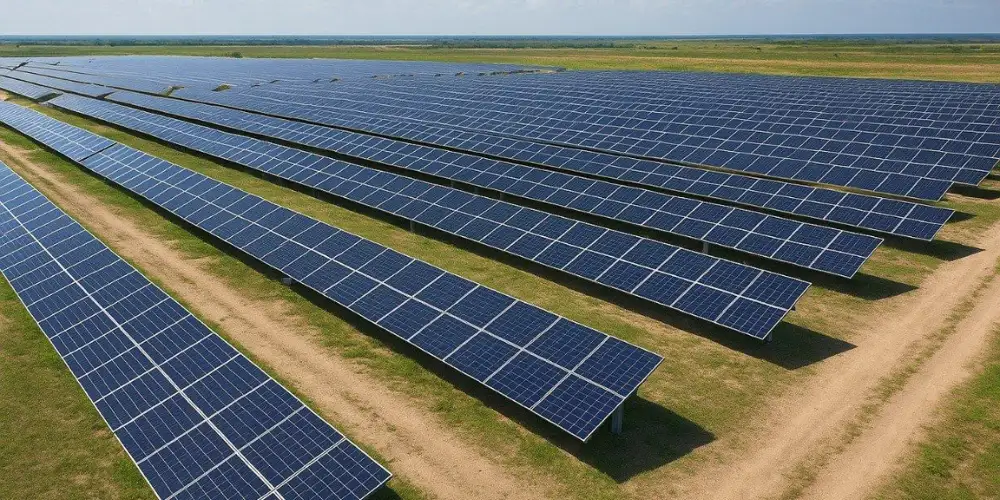
The Dholera Solar Park is an ultra-mega solar project planned within the Dholera SIR in Gujarat’s Ahmedabad district region.
The Gujarat government approved the park in April 2018 with a planned capacity of 5,000 MW. At the time, it was announced as India’s largest single-location solar park. Larger renewable projects, such as the Khavda park in Kutch, have since been announced in Gujarat, but Dholera remains an important project for the state.
More recent descriptions of the project put its capacity at 4,400 MW, so you will see both figures online. The 5,000 MW figure comes from the original announcement, while 4,400 MW is the number used in newer project summaries.
The park is shared by several developers. Companies win capacity through auctions and then build their own solar plants on allotted plots.
This structure makes it easier for several companies to work on one site, which suits a project of this size.
Dholera Solar Park Location and Key Facts
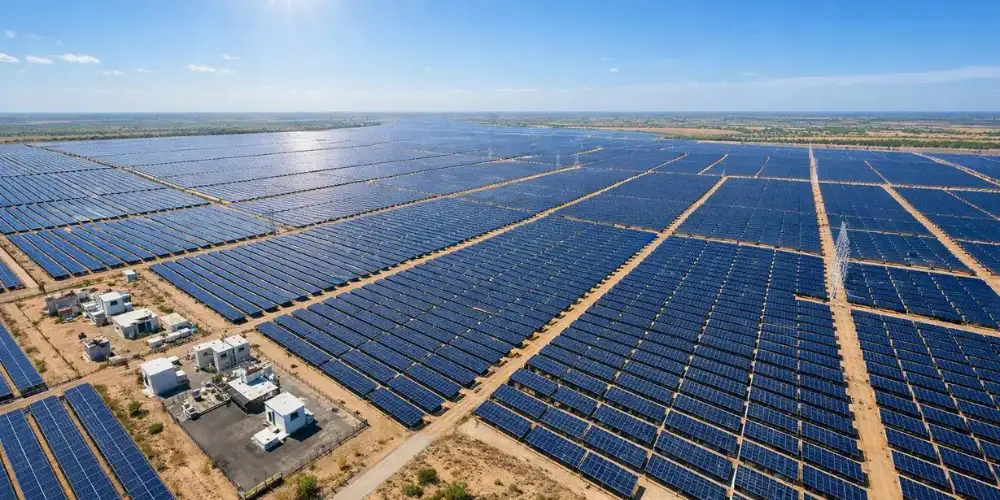
The park is located in the Dholera area, roughly 80 km from Ahmedabad, along the Gulf of Khambhat.
Its land falls within a Coastal Regulation Zone (CRZ) 1B area, between the high-tide and low-tide lines. The location also has a strategic benefit. The site lies within the Dholera SIR and close to its activation area, the first zone being developed for industry and urban use.
That means power generation is being planned next to a growing industrial and urban hub rather than in a remote corner of the state.
Connectivity around the region is also improving. The 109 km Ahmedabad-Dholera Greenfield Expressway has opened for public use in 2026, making the area far easier to reach from Ahmedabad.
Here is a quick summary of the main project details:
| Detail | Information |
| Location | Dholera SIR, Gujarat, along the Gulf of Khambhat |
| Distance from Ahmedabad | About 80 km |
| Planned capacity | 5,000 MW announced; 4,400 MW in recent summaries |
| Phase 1 capacity | 1,000 MW |
| Commissioned so far | 300 MW by Tata Power |
| Planned area | About 11,000 hectares (roughly 27,000 acres) |
| Early cost estimate | About ₹25,000 crore |
| Layout | 11 blocks, divided into smaller plots |
| Procurement | Competitive bidding and reverse e-auction |
These figures come from different stages of the project, and some have changed over time. For example, the area is reported as 11,000 hectares in most coverage, while one project profile lists 8,595 hectares. Treat early cost and area figures as estimates rather than final numbers.
Project Timeline and Current Status
The Dholera Solar Park has moved forward in stages. These are the main milestones:
- 2009: The Dholera smart city project is announced.
- April 2018: Gujarat approves the 5,000 MW solar park.
- May 2018: The Ministry of New and Renewable Energy approves the project.
- February 2019: Conditional approval is received for the first phase.
- May 2019: Tata Power wins 250 MW in an auction led by Gujarat Urja Vikas Nigam Limited (GUVNL). Its allocation later reaches 300 MW.
- March 2020: Construction begins on Tata Power’s project.
- October 2020: Tata Power is awarded a further 100 MW from a 700 MW auction, taking its total to 400 MW.
- April 2022: Tata Power commissions its 300 MW solar project at Dholera.
Today, the 1,000 MW first phase is under implementation, and 300 MW of it has been commissioned by Tata Power. Later phases depend on further tenders and clearances.
So the park is partly operational, but the bulk of its planned capacity is still to come. This is an important point for readers, because many articles describe the full 5,000 MW as if it already exists.
The Technology Behind the Park

Tata Power’s 300 MW project gives the clearest picture of what has actually been built at the site.
The plant spans 1,320 acres, split into six plots of 220 acres each. It uses 873,012 monocrystalline PV modules.
When it was commissioned, the project was reported as India’s largest single-axis tracker installation. Single-axis trackers slowly tilt the panels through the day to follow the sun. This helps a plant capture more sunlight than fixed panels can.
Planning documents for the wider park also describe a 49 km underground 33 kV cable network to carry electricity across the site to substations. Early project specifications referred to poly-crystalline modules, but technology has changed quickly since then, and Tata Power’s plant uses monocrystalline panels.
Future developers may choose different equipment, depending on when their projects are built.
The electricity is supplied into the grid under power purchase arrangements with utilities such as GUVNL. Tata Power’s 100 MW award, for example, will supply power to GUVNL on a build-own-operate basis.
In simple terms, the park strengthens Gujarat’s power supply as a whole. It is not a private supply line for nearby homes or plots.
Challenges Every Reader Should Know
A balanced view of the Dholera Solar Park should include the difficulties it has faced.
Site conditions: The Gulf of Khambhat area has muddy ground and salt marshes, and it can flood during the monsoon. Industry reports noted that these conditions made some developers cautious about bidding.
Mixed auction results: In one 2019 auction, GUVNL hoped to allocate 1 GW but awarded only a quarter of that. Later, the state also retendered 700 MW of capacity.
Environmental review: An expert committee recommended coastal clearance for the 1,000 MW first phase, but reserved further clearance until it had assessed studies on migratory birds and sea-level rise. Additional capacity therefore depends on further approvals.
Cancelled allocations: Not every award has moved ahead. Global Energy Monitor lists the 100 MW projects linked to SJVN and Vena Energy as cancelled.
None of this rules out future growth. It simply shows why timelines for large infrastructure projects should be checked rather than assumed.
What the Solar Park Means for Dholera and Investors

The Dholera Solar Park is one part of a much larger development story.
Dholera SIR is planned across about 920 square kilometres, with a vision to house over 2 million people. Alongside the solar park, the region is seeing major projects such as the Ahmedabad-Dholera Expressway, the Dholera International Airport and Tata’s semiconductor investment.
In July 2026, Gujarat’s Data Centre Policy 2026-29 also named Dholera as its primary hub. Data centres and chip plants both need large amounts of dependable power, so energy infrastructure nearby strengthens the region’s industrial case.
For the local economy, a project of this kind can bring:
- Construction and maintenance work in the region
- Stronger clean energy credentials for Dholera
- A better case for attracting power-hungry industries
- More government and private attention on the area
For real estate buyers, the solar park is best seen as one supporting factor. Plot values depend on many things, including location, approvals, connectivity and the pace of actual development. No infrastructure project can guarantee returns.
Before you buy any plot in Dholera, check the following:
- Title documents and land status
- Town planning (TP) scheme zoning
- Non-agricultural (NA) status and RERA registration, where applicable
- Real distance from completed roads and infrastructure
At Angel Nova Group, we believe informed buyers make better decisions. If you are exploring opportunities in Dholera, our team can walk you through the region’s progress and help you understand your options.
FAQs About the Dholera Solar Park
It was approved at 5,000 MW. Recent project summaries list 4,400 MW, with 1,000 MW in Phase 1.
Partly. Tata Power commissioned 300 MW in 2022. The rest of the planned capacity is still to be developed.
It is in the Dholera Special Investment Region in Gujarat, about 80 km from Ahmedabad, along the Gulf of Khambhat.
The park sits within DSIR, and capacity is awarded to developers through auctions. Tata Power is the main developer with an operating project there.
Most reports say about 11,000 hectares, or roughly 27,000 acres. One project profile lists 8,595 hectares.