


Every time you stream a movie, make a UPI payment or ask an AI chatbot a question, that data lives somewhere. That somewhere is a data centre.
Gujarat now wants to be the place where much of India’s data lives. And the response from investors has been far bigger than anyone expected.
The Big Number: More Than Double the Target
Gujarat set itself a target of 7.5 GW of data centre capacity. Within weeks, the proposals had more than doubled that figure.
Science and Technology Minister Arjun Modhwadia told the state Assembly that Gujarat has received expressions of interest for around 17 GW from 17 parties, covering 19 projects.
If every proposal moves ahead, the state could see more than ₹17 lakh crore in investment, with interest coming from both Indian and global companies.
Why 7.5 GW Is Already a Huge Goal

To understand the scale, compare it with the whole country. India currently has about 1.5 GW of data centre capacity, which is roughly 2 per cent of the global total, while the US has 53 GW.
That means Gujarat alone is aiming for five times what all of India runs today. The 17 GW of proposals is more than ten times the national figure.
A Quick Look at the Numbers
| Detail | Figure |
| Policy target | 7.5 GW |
| Capacity proposed | About 17 GW |
| Companies interested | 17 |
| Projects proposed | 19 |
| Potential investment | Over ₹17 lakh crore |
| India’s current capacity | About 1.5 GW |
| Extra subsidy for Dholera | 2.5% capital subsidy |
The Policy Behind the Rush
All of this started with a single policy. The Viksit Gujarat Data Centre Policy 2026–29 was announced on July 9.
Gujarat says it is the first Indian state to have a dedicated policy of this kind. The incentives are what caught investors’ attention.
The package includes up to 4% interest subsidy for 10 years and a power tariff subsidy of ₹1 per unit for 20 years. It also offers SGST reimbursement and refunds on stamp duty and registration fees.
There is another key benefit. Data centres will be treated as an essential service under the Gujarat Essential Services Maintenance Act, which helps keep operations running without disruption.
Why Dholera Is in the Spotlight
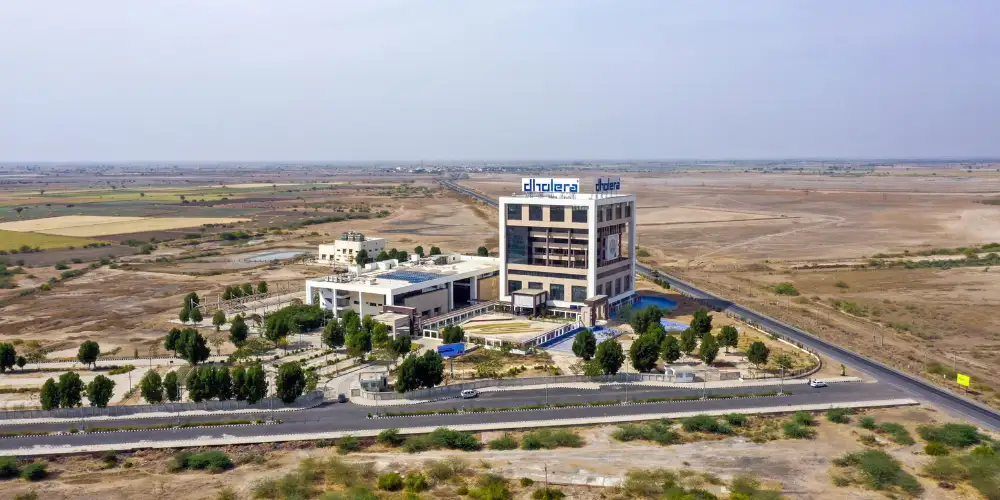
Dholera is not just another location on the map. The state is actively pushing it as its main data centre zone.
Projects set up in Dholera qualify for an extra 2.5% capital subsidy. That makes it more attractive than most other sites in the state.
The government’s plans for Dholera are bold. Officials expect the region alone to host a 7 to 8 GW data centre cluster, drawing about ₹6–7 lakh crore in investment.
Deputy Chief Minister Harsh Sanghavi has said Dholera could become the world’s largest “data centre city.”
What Gives Dholera an Edge
Dholera Special Investment Region (SIR) was planned from scratch as a smart industrial city. It has wide roads, planned zones and space to grow.
The region already has major tech backing. The foundation for Tata Electronics’ ₹91,000-crore semiconductor plant was laid in Dholera SIR in March 2024.
A chip plant and data centres in the same region can feed each other. Together, they can build a strong tech ecosystem.
Green Power Is Not Optional

Data centres use massive amounts of electricity. Gujarat has made sure this growth stays clean.
Under the policy, data centre operators must get at least 51% of their power from renewable sources.
Gujarat’s solar and wind strength makes this possible. It also makes the state appealing to global tech firms with strict climate goals.
Why This Matters for India

The AI boom needs computing power, and computing power needs data centres. Modhwadia described data centres as the oil wells of today, saying the policy aims to put Gujarat at the front of India’s AI revolution.
More capacity at home means Indian data can stay in India. It also means faster services, stronger digital security and thousands of skilled jobs.
A Reality Check
Proposals are not the same as finished projects. Expressions of interest show demand, but each project still has to secure land, power, water and approvals.
Building data centres is also costly. Officials estimate that a single 1 GW data centre needs between ₹70,000 crore and ₹1 lakh crore in investment.
Still, a response this strong sends a clear signal. Investors see Gujarat, and especially Dholera, as a serious long-term bet.
The Road Ahead
Gujarat has made its pitch, and the market has answered loudly. The next three years will show how much of this 17 GW turns into working facilities.
If even half of it comes to life, Dholera could change from a planned city on paper to one of the busiest digital hubs in Asia.
Frequently Asked Questions
Gujarat has received proposals for about 17 GW of capacity from 17 companies across 19 projects.
The Viksit Gujarat Data Centre Policy 2026–29 aims for 7.5 GW of capacity.
If all of them are carried out, they could bring in over ₹17 lakh crore.
Dholera projects get an extra 2.5% capital subsidy, and the state sees it as a future data centre city.
Capital and interest subsidies, power tariff support, SGST reimbursement, and refunds on stamp duty and registration fees.