

Introduction
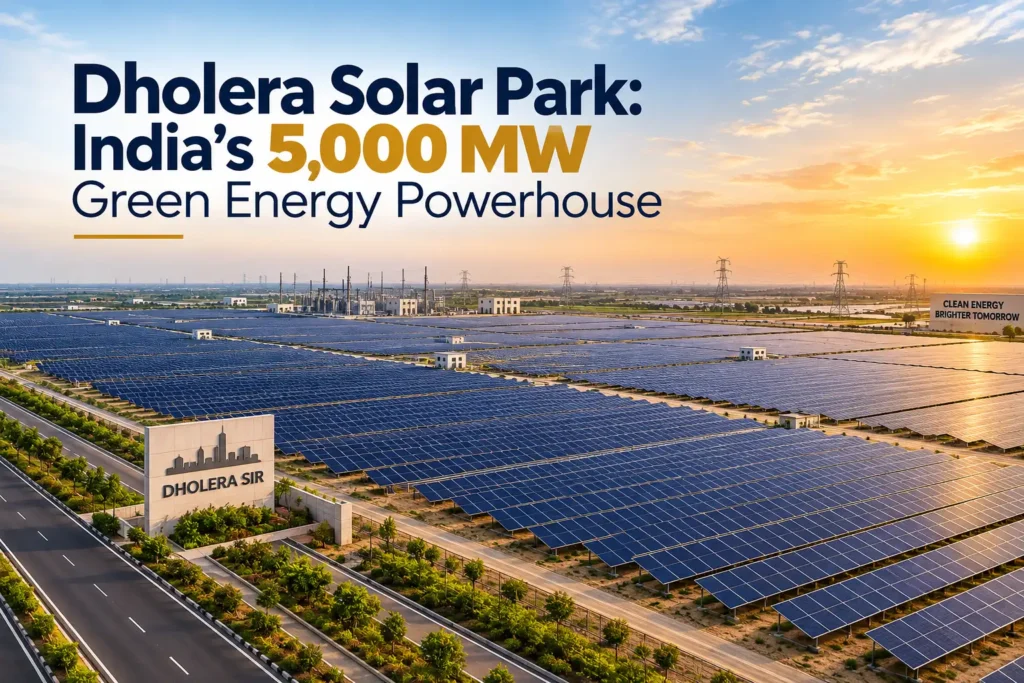
Gujarat has quietly become the centre of India’s clean energy story, and Dholera Solar Park sits right at the heart of it. Planned as a 5,000 MW ultra mega solar project inside the Dholera Special Investment Region (DSIR), it is one of the largest single-location solar developments anywhere in the world.
For anyone tracking Dholera, this project is more than a power plant. It is the energy backbone that will run a semiconductor fab, industrial parks, data centres and an entire greenfield smart city. At Angel Nova Group, we watch these infrastructure milestones closely, because reliable power is one of the strongest indicators of long-term growth in any region.
Here is a clear, jargon-free look at what Dholera Solar Park is, where it stands today, and why it matters.
1. What Is Dholera Solar Park?
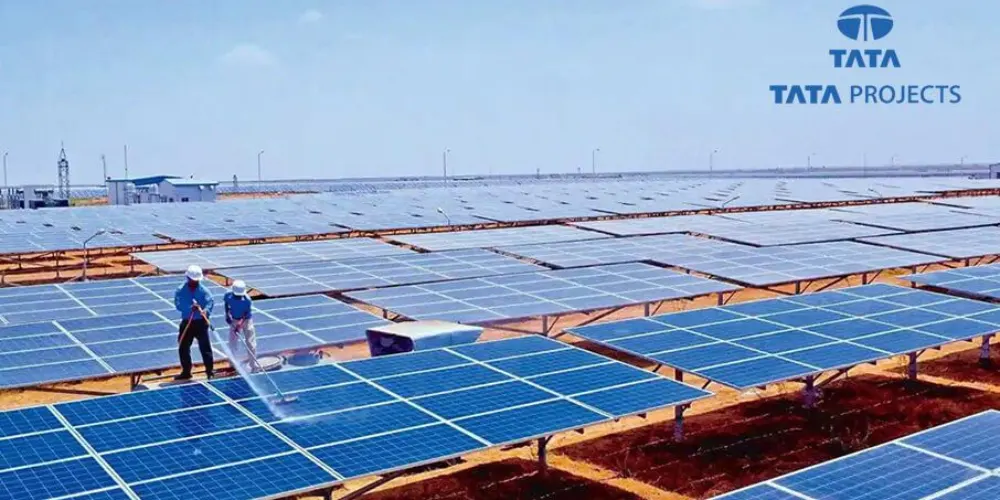
Dholera Solar Park is a large-scale photovoltaic park being developed in Dholera SIR, Gujarat, and classified by the Ministry of New and Renewable Energy as an Ultra Mega Solar Power Project. Instead of one company building one plant, the park model creates shared land, transmission and evacuation infrastructure, and multiple developers then set up individual solar plants inside it.
That structure is what makes the scale possible:
- Planned capacity: around 5,000 MW (5 GW)
- Land footprint: several thousand hectares, divided into blocks and plots
- Plot sizes: typically allotted in blocks of roughly 100–200 MW per developer
- Model: public-private partnership, with government agencies handling common infrastructure
- Target: full 5 GW capacity by 2030
The first major block, Tata Power’s 300 MW plant, was commissioned in April 2022 and later expanded, making it one of the earliest operational pieces of the park.
2. Dholera Solar Park Location: Why Gujarat, Why Dholera
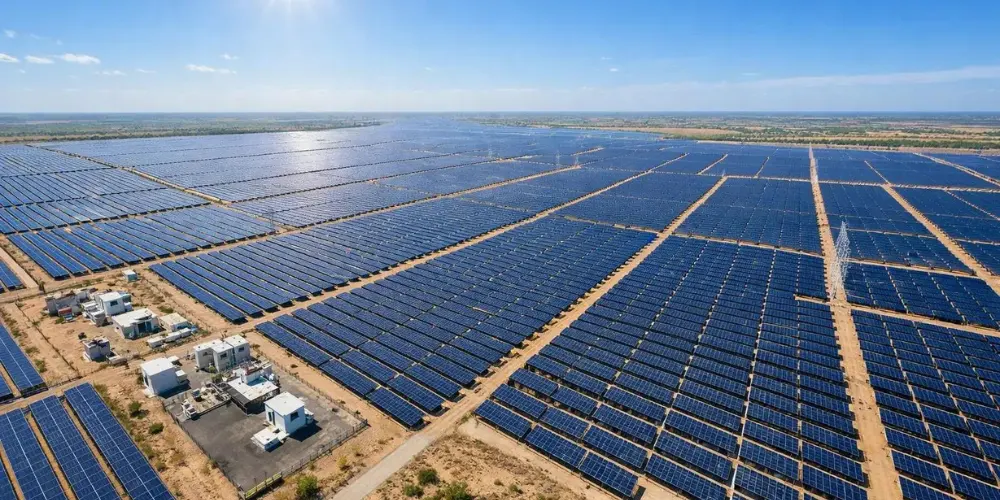
Location is not an accident here. Dholera sits roughly 100 km from Ahmedabad in the Bhal region of Gujarat, an area with high solar irradiance, long clear-sky periods and large stretches of low-productivity land that are unsuitable for intensive farming.
What the location offers:
- High solar radiation for most of the year, which lifts generation per installed megawatt
- Flat, open terrain that keeps construction and layout costs efficient
- Minimal agricultural displacement, since much of the land is saline and low-yield
- DMIC connectivity, as Dholera lies on the Delhi–Mumbai Industrial Corridor
- Proximity to demand, with industrial users coming up inside the same region
That last point is important. Most large solar parks send power hundreds of kilometres away. Dholera generates clean power right next to the industries that will consume it.
3. Capacity and Development Phases
Dholera Solar Park is being built in stages rather than all at once. This phased approach lets the grid infrastructure, developer tendering and transmission capacity scale together instead of one racing ahead of the other.
The broad development sequence looks like this:
- Phase 1: initial blocks of a few hundred megawatts, including the commissioned Tata Power plant
- Intermediate phases: additional capacity allotted through competitive bidding and reverse e-auctions
- Final target: total installed capacity of about 5,000 MW
Developers are selected through transparent tendering. Interested companies submit expressions of interest, bid competitively, and the lowest viable tariffs win. This process has helped push solar tariffs in Gujarat to some of the most competitive levels in the country, with reported bids in the range of ₹2.3–2.5 per unit for certain blocks.
4. Who Is Developing Dholera Solar Park?
The project is coordinated by state and central agencies working together, which is one reason it has moved ahead steadily despite its size.
Key organisations involved:
- GUVNL (Gujarat Urja Vikas Nigam Ltd): nodal agency and primary power purchaser
- GPCL (Gujarat Power Corporation Ltd): solar park development and land facilitation
- GETCO (Gujarat Energy Transmission Corporation): state-level transmission
- SECI (Solar Energy Corporation of India): central policy and implementation support
- CTU (Central Transmission Utility): interstate transmission linkage
- Private developers: Tata Power and other selected bidders operating individual blocks
Long-term power purchase agreements, typically 25 years, give developers revenue visibility and give the state predictable tariffs.
5. Power Transmission and Grid Infrastructure
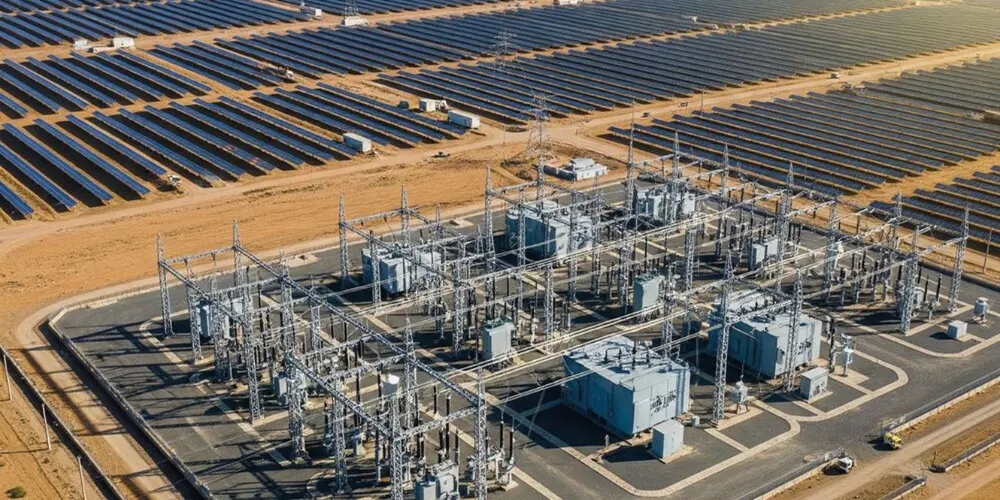
A solar park is only as useful as its ability to move electricity. Dholera has been planned with evacuation infrastructure built in from the start, not added later.
The transmission setup includes:
- Dedicated pooling substations inside the park
- High-voltage lines connecting to the state grid through GETCO
- Interstate transmission access via CTU for power sold outside Gujarat
- Grid integration designed to handle variable solar output
- Provision for future storage and hybrid capacity as technology matures
For Dholera SIR itself, this means industrial plots can be marketed with a credible promise of green, uninterrupted power, which is now a procurement requirement for many global manufacturers.
6. Environmental and Economic Impact
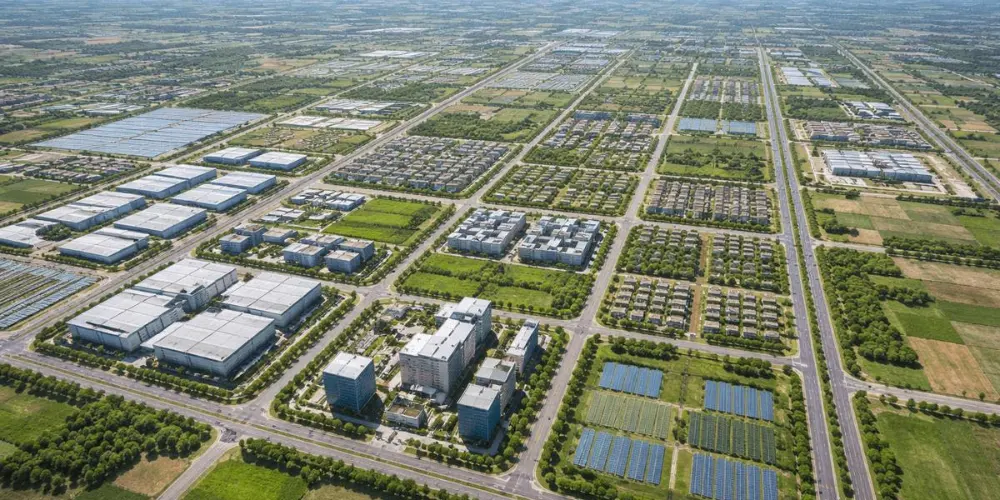
The environmental case is straightforward. Every megawatt-hour generated here displaces electricity that would otherwise come from coal, cutting carbon emissions without consuming water or fuel during operation.
The benefits extend past emissions:
- Lower carbon footprint for industries operating inside Dholera SIR
- No fuel or water consumption during day-to-day generation
- Productive use of saline, low-yield land
- Employment generation across construction, operations, maintenance and cleaning
- Local economic activity in logistics, housing, services and skilled trades
- Contribution to India’s target of 500 GW non-fossil capacity by 2030
Large solar parks are not entirely impact-free. Land use, panel end-of-life recycling and water for module cleaning all need careful management, and these are areas where planning standards continue to improve.
7. What Dholera Solar Park Means for Investors
Infrastructure of this scale changes the profile of an entire region. Power availability is one of the first questions any manufacturer asks before committing capital, and Dholera now has a strong answer.
Why this matters for anyone looking at Dholera:
- Industrial anchoring: reliable green power attracts semiconductor, electronics and manufacturing units
- Employment growth: more industry means more workers, and more demand for housing
- Credibility signal: commissioned capacity shows execution, not just announcements
- Sustainability premium: global buyers increasingly prefer suppliers running on renewable power
- Long development runway: capacity targets extending to 2030 mean sustained activity
Angel Nova Group works with clients who want to understand Dholera through its fundamentals, including power, connectivity, water and approvals, rather than through hype. Solar capacity is one of the clearest fundamentals on that list.
Conclusion
Dholera Solar Park is one of the clearest signs that Dholera SIR is being built for the long term. Clean power at this scale, backed by state agencies and established developers, gives the region something most industrial zones in India are still working towards.
If you are evaluating opportunities in Dholera and want an honest read on what is built, what is under construction and what is still on paper, get in touch with Angel Nova Group for a detailed, fact-based consultation.
Frequently Asked Questions
It is planned for approximately 5,000 MW (5 GW), with capacity being added in phases and full build-out targeted by 2030.
Inside the Dholera Special Investment Region in Gujarat, roughly 100 km from Ahmedabad, along the Delhi–Mumbai Industrial Corridor.
Partly. Initial blocks, including a Tata Power plant commissioned in 2022, are generating power. Remaining capacity is under development.
GUVNL is the nodal agency, supported by GPCL, GETCO, SECI and CTU, with private developers selected through competitive bidding.
It supplies clean, competitively priced power to industries and residents in the region, which strengthens Dholera’s case as a manufacturing destination.