

Dholera Smart City has just received one of its biggest infrastructure signals yet. Western Railway has invited bids for the construction of the Sarkhej–Dholera Semi High-Speed Double Rail Line, a project that will directly link Ahmedabad with Dholera SIR.
At an estimated EPC value of ₹18,901.68 crore, this is a major milestone in the making of India’s first semi high-speed railway corridor built on indigenously developed technology.
At Angel Nova Group, we track infrastructure developments that shape the long-term growth of Dholera and the surrounding region. Here’s a clear breakdown of what this tender means.
Western Railway Invites Bids for the Dholera Rail Corridor
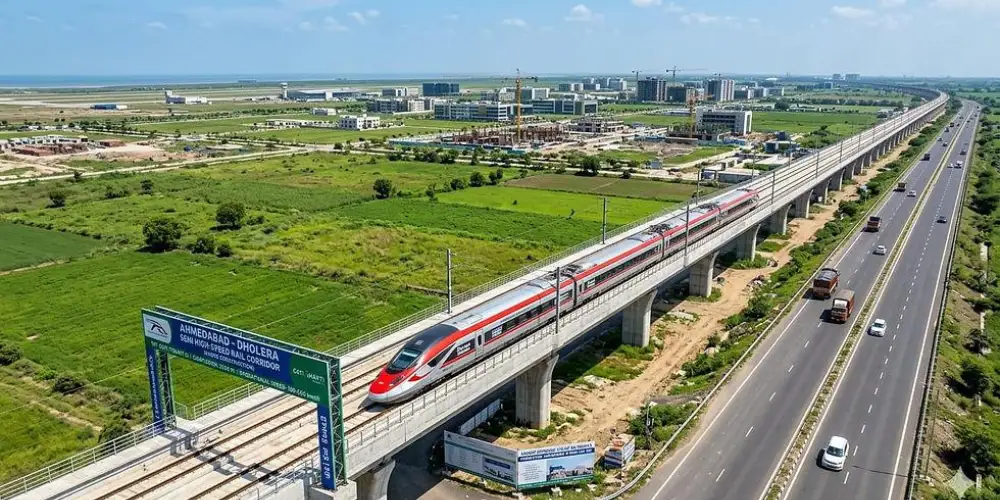
The tender covers the full engineering, procurement and construction (EPC) package for the double-line corridor between Sarkhej in Ahmedabad and Dholera.
The scope is comprehensive. A single contractor will be responsible for civil works, track laying, electrification, signalling, telecommunications, testing and commissioning — a turnkey mandate that keeps execution accountability with one agency.
The overall project cost, including land and allied components, is estimated at around ₹20,667 crore, making it a flagship project of the Ministry of Railways.
Sarkhej–Dholera Rail Tender: Key Details
| Information | Details |
| Tender Number | CPMSHSRADIWRSEJDSIREPC01 |
| Project | Sarkhej–Dholera Semi High-Speed Double Railway Line |
| Estimated EPC Cost | ₹18,901.68 crore |
| Earnest Money Deposit (EMD) | ₹378.03 crore |
| Completion Period | 42 months |
| First Pre-Bid Meeting | 7 September 2026, 11:30 AM |
| Second Pre-Bid Meeting | 25 September 2026, 11:30 AM |
| Bid Validity | 180 days |
The 42-month completion window means that, once awarded, the corridor could realistically move toward commissioning within the next four to five years.
What the Selected Contractor Will Build
The awarded agency will deliver the corridor complete in all respects under the jurisdiction of Western Railway. The scope includes:
- Civil works — formation and viaduct, bridges, station buildings and associated structures
- Track system — both ballasted track and ballastless track (BLT)
- Overhead traction system, including electrical general services
- Signalling and telecommunication systems
- Operating Control Centre for corridor-wide train management
- Spur lines to the Lothal National Maritime Heritage Complex (NMHC) and the Dholera Airport terminal
- Integration, testing and commissioning of all systems
Two Spur Lines That Change the Picture

Beyond the main Sarkhej–Dholera alignment, two spur lines carry outsized importance:
Dholera International Airport spur — Direct rail access to the airport terminal creates a genuine multimodal hub. Passengers will be able to move between Ahmedabad and the airport without depending solely on road transport.
Lothal NMHC spur — Lothal is one of the most significant Harappan sites in India, and the National Maritime Heritage Complex is being developed as a major tourism destination. Rail connectivity opens it up to domestic and international visitors.
Together, these spurs turn a point-to-point line into a connected network serving industry, aviation, tourism and daily commuters.
India’s First Semi High-Speed Rail Using Indigenous Technology
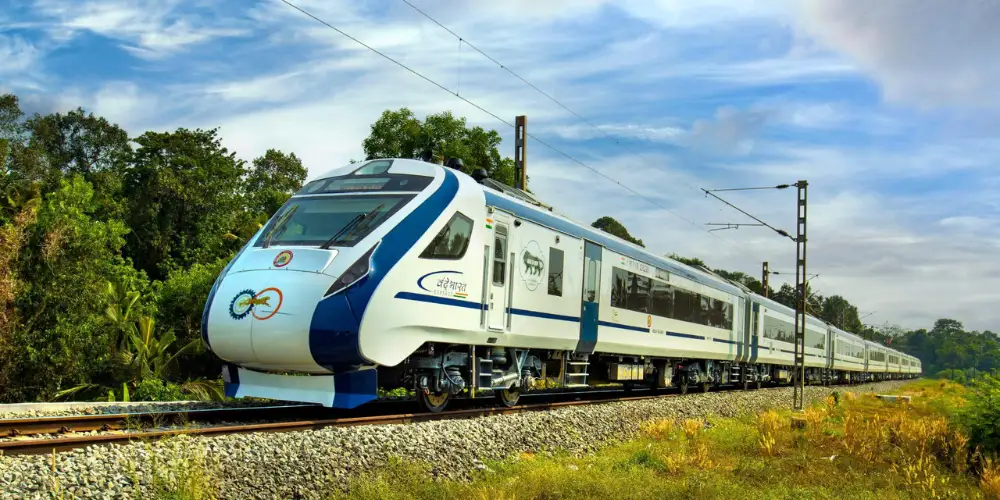
This corridor is planned as Indian Railways’ first semi high-speed rail project built with indigenously developed technology. That distinction matters.
It positions Gujarat — and Dholera specifically — as the testing ground for a rail standard that could be replicated across other corridors in India. For a region already anchored by semiconductor manufacturing and a greenfield airport, being first in line for next-generation rail adds another layer of strategic value.
Planned Under the PM Gati Shakti National Master Plan
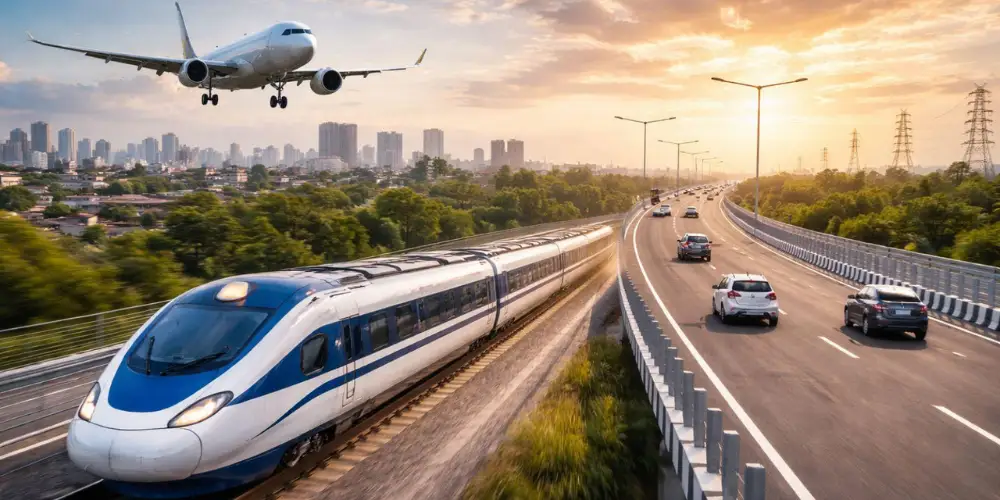
The project has been conceived under the PM Gati Shakti National Master Plan, the government’s framework for integrated, multimodal infrastructure planning.
The practical effect is that this rail line is not being built in isolation. It is designed to work alongside:
- The Ahmedabad–Dholera Expressway
- Dholera International Airport
- Industrial and logistics infrastructure inside Dholera SIR
- Port connectivity along the Gulf of Khambhat
This coordination is what improves logistics efficiency and reduces the cost of moving goods and people.
What It Means for Dholera SIR
Faster rail connectivity changes how people relate to a location. A few practical outcomes:
- Shorter travel time between Ahmedabad and Dholera SIR
- Same-day return trips become convenient for business and site visits
- Daily commuting becomes realistic, widening the labour pool for Dholera’s industries
- Workforce mobility improves for semiconductor, manufacturing and logistics units setting up in the region
- Tourism inflow rises with Lothal NMHC on the network
For a planned smart city, reliable mass transit is the difference between an industrial zone and a liveable city. This tender moves Dholera toward the latter.
Why Investors Are Watching
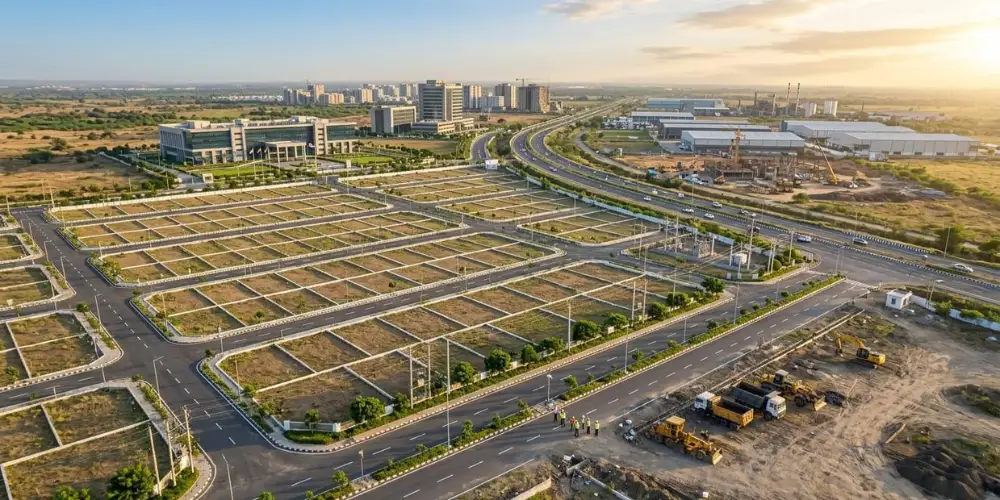
Infrastructure milestones tend to precede demand. Land parcels near planned transit corridors, airports and expressways historically attract earlier interest than areas without confirmed connectivity.
With the EPC tender now floated, the Dholera rail corridor has moved from announcement to procurement — a meaningful shift in project certainty. Combined with the airport, the expressway and ongoing semiconductor investments, the connectivity story around Dholera SIR is becoming more concrete each quarter.
Final Thoughts
The ₹18,901.68 crore EPC tender for the Sarkhej–Dholera Semi High-Speed Double Rail Line is one of the most significant infrastructure updates for Gujarat this year. It brings Ahmedabad, Dholera SIR, Dholera International Airport and Lothal NMHC onto a single high-speed network.
Angel Nova Group continues to follow these developments closely and share timely, accurate insights on the evolving growth story of Dholera Smart City.
Frequently Asked Questions
It is a double-line semi high-speed railway corridor connecting Sarkhej in Ahmedabad with Dholera, including spur lines to Dholera Airport and Lothal NMHC.
The EPC contract is estimated at ₹18,901.68 crore. The overall project cost is around ₹20,667 crore.
The tender specifies a completion period of 42 months from award.
The first pre-bid meeting is on 7 September 2026 and the second on 25 September 2026, both at 11:30 AM.
Civil works, viaducts, bridges, stations, ballasted and ballastless track, overhead traction, signalling and telecom, an Operating Control Centre, and full testing and commissioning.