

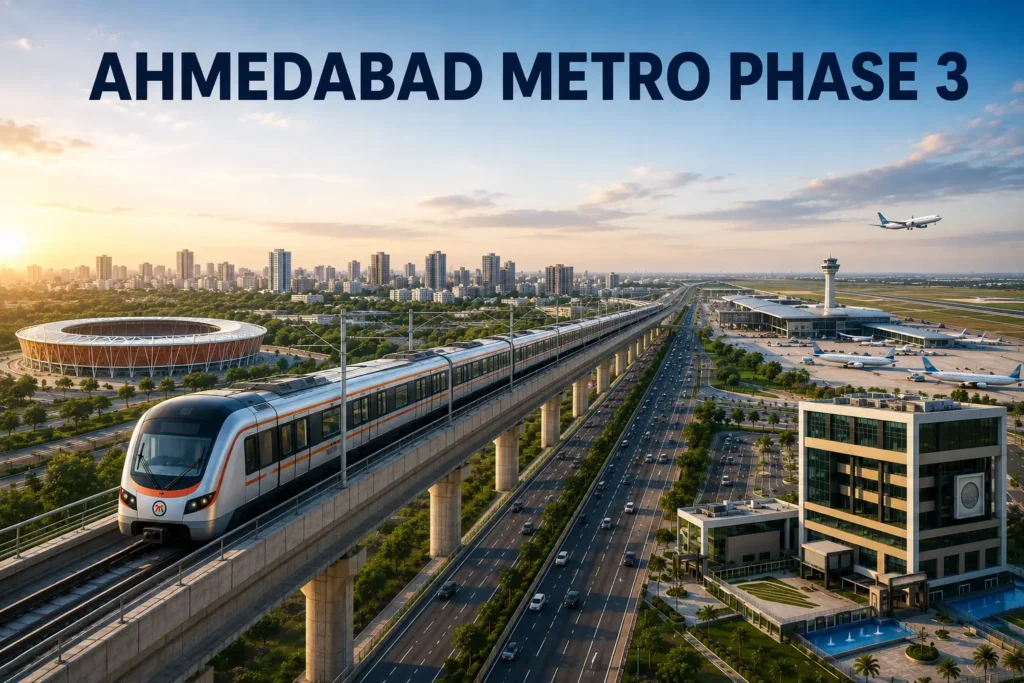
Ahmedabad is about to write a new chapter in its urban mobility story. The Gujarat Metro Rail Corporation (GMRC) has moved beyond file approvals and started actual ground preparation for the city’s next big transit leap.
Ahmedabad Metro Phase 3 has cleared the Public Investment Board (PIB) stage and now awaits the Union Cabinet’s final sanction. But GMRC is not waiting idle. Pre-construction activity is already underway on the proposed corridors.
For anyone tracking Gujarat’s growth corridors — homebuyers, investors, developers and businesses alike — this is a development worth reading closely.
1. From Paper Approval to Ground Preparation
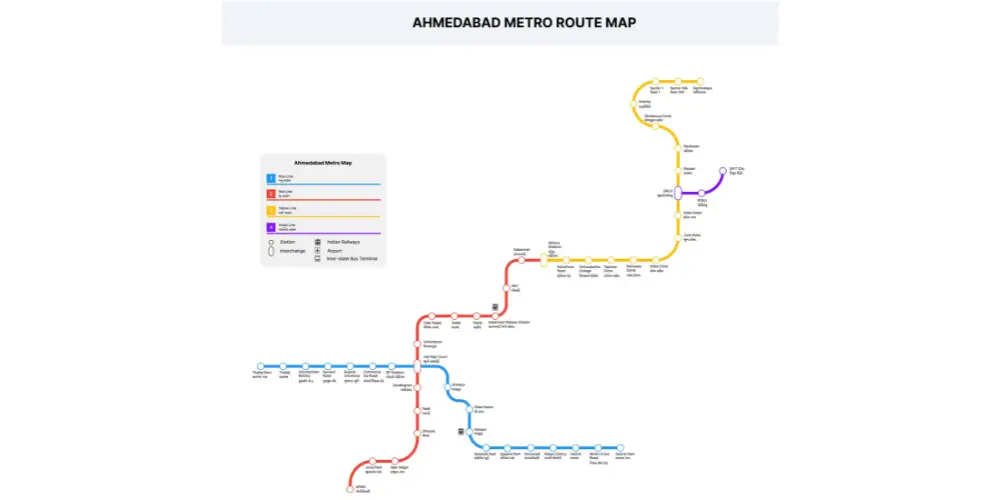
The most important signal in the Ahmedabad Metro Phase 3 update is not the approval itself. It is the shovel-ready groundwork that has begun before the final nod.
GMRC has taken up utility shifting first — the relocation and protection of underground and overground services along the main alignment. This is always the first physical step in any metro project.
Key points on the current status:
- PIB clearance has been granted to Ahmedabad Metro Phase 3
- Union Cabinet approval is pending before civil construction can formally begin
- Detailed Design Consultants (DDCs) have been appointed to finalise structural alignments
- Geotechnical investigation and survey work has been initiated
- The overall phase is estimated at around ₹2,825 crore
By front-loading this preparatory work, GMRC is compressing the timeline between cabinet approval and the first pier being cast.
2. ₹35.81 Crore in 4 Packages: What Utility Shifting Really Involves
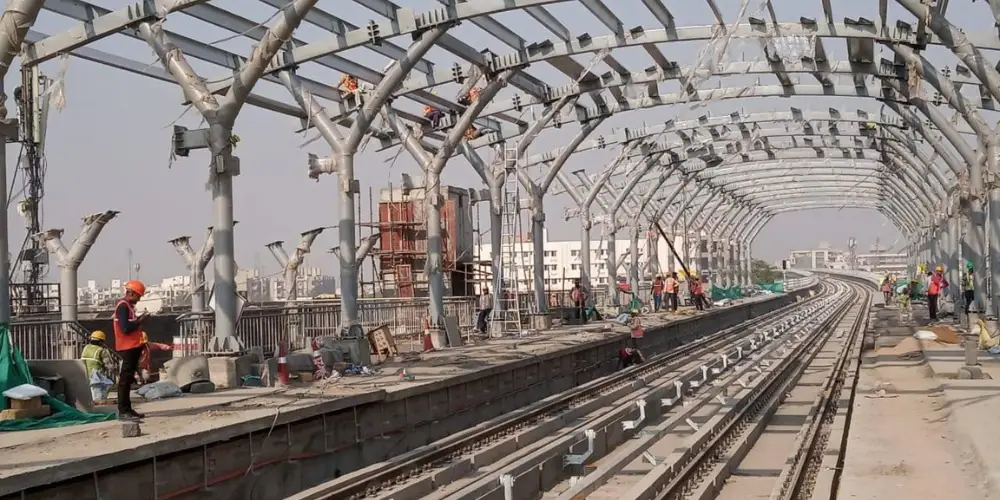
Before heavy civil construction starts on Ahmedabad Metro Phase 3, every civic service sitting in the alignment’s path must be moved to a safe location. GMRC has floated four separate utility shifting packages worth ₹35.81 crore for this purpose.
These tenders cover stretches of Phase 3B, Phase 3C and the Gyaspur depot area.
The services being shifted or protected include:
- Water supply pipelines — municipal mains crossing the corridor
- Electricity cables — both underground and overhead power infrastructure
- Gas network lines — piped natural gas distribution
- Sewage and drainage systems — trunk lines and connections
- Telecom and optical fibre cables — data and communication backbones
The objective is straightforward: residents along the route should not face water cuts, power outages or network disruption once major construction starts. It is unglamorous work, but it decides whether a metro project runs on schedule or slips by years.
3. 60 KM and 41 Stations: The Proposed Network
The headline numbers for Ahmedabad Metro Phase 3 are a roughly 60 km network with 41 elevated stations. Some reports place the figure at 42 stations, and the final count will be confirmed with cabinet sanction.
A significant portion of the phase is planned as Metro-cum-Regional Rapid Transit System (RRTS) hybrid corridors. Three such corridors together span about 48.48 km with 32 elevated stations:
| Corridor | Length | Stations |
| Vakil Bridge – Badrabad | 12.38 km | 6 |
| APMC – Rakhiyal | 14.5 km | 11 |
| Malek Saheban Stadium – Nehrunagar | 21.6 km | 15 |
Alongside these, a circular corridor is proposed to begin and end at Vadaj, looping through the western, eastern and southern parts of the city. Locations such as Akhbarnagar, Naranpura and Amraiwadi feature on this ring alignment.
Major interchanges are planned at Gujarat University, APMC, Amraiwadi and Vadaj. The design intent is to let commuters move between the city’s quadrants without funnelling through the crowded central business district — a genuine decongestion strategy rather than just added kilometres.
4. The Dholera Airport Link: Why Badrabad Matters

This is the part of Ahmedabad Metro Phase 3 that carries the longest-term significance.
A key corridor runs from Thaltej Gam to Badrabad via Godhavi. The alignment is planned to begin near Shilaj Canal Road, follow the Sardar Patel Ring Road, and pass important nodes such as Bopal and Shantipura before terminating at Badrabad near the Ahmedabad–Dholera Expressway.
Badrabad is being positioned as a future interchange point from which the network can be extended towards:
- Dholera Special Investment Region (SIR)
- Dholera International Airport
That single design decision changes the character of the project. Ahmedabad Metro Phase 3 stops being a city transit upgrade and becomes the first rail spine of an emerging Ahmedabad–Dholera regional economy.
Dholera SIR is India’s first greenfield smart city, anchored by semiconductor manufacturing, an expressway, a dedicated freight link and an international airport. A metro-grade connection to that ecosystem — even as a phased extension — is a structural shift, not an incremental one.
5. The Commonwealth Games Venue Connection
Ahmedabad Metro Phase 3 also includes a direct link to the South West Ahmedabad Sports Arena (SWASA) at Godhavi.
This complex is central to Gujarat’s ambitions around hosting the 2030 Commonwealth Games. Global sporting events demand mass transit capacity, and a metro station serving the arena is a prerequisite rather than a nice-to-have.
What this means in practice:
- Direct rail access to a marquee sports and events destination
- Improved connectivity for the developing Godhavi–Shantipura belt
- Infrastructure built for peak-event loads, benefiting daily commuters year-round
- A credibility boost for Gujarat’s event-hosting bid
The target for completion currently under discussion is around 2030, aligning with that broader timeline.
6. What Ahmedabad Metro Phase 3 Means for Real Estate
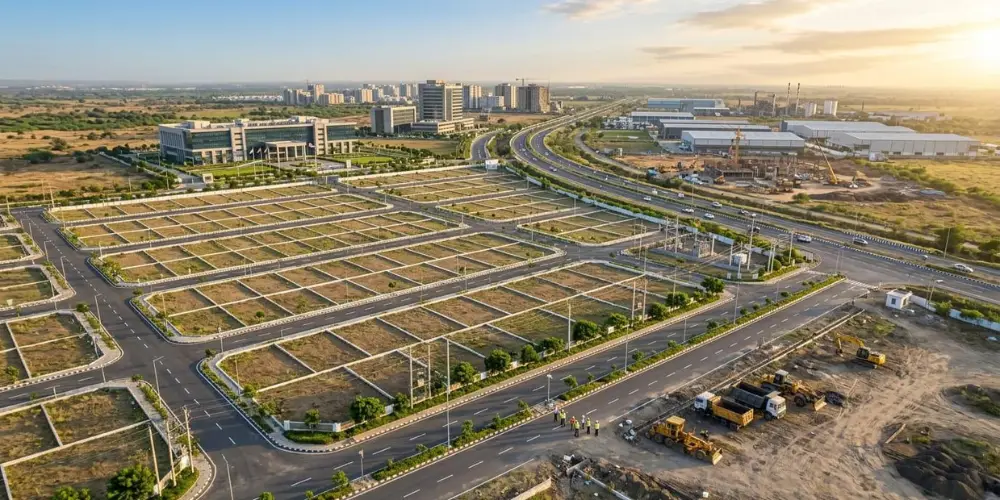
At Angel Nova Group, we track infrastructure because infrastructure is what converts land into location.
The proposed alignment touches or passes close to several residential and emerging growth pockets:
- Established markets: Thaltej, Bopal, Shilaj, Nehrunagar
- Growth corridors: Godhavi, Shantipura, Badrabad
- Regional play: the Ahmedabad–Dholera Expressway belt and Dholera SIR
The pattern in Indian metro cities is consistent. Corridors along a confirmed metro alignment tend to see interest build in three waves — at announcement, at construction commencement, and at operational launch.
Ahmedabad Metro Phase 3 is currently between the first and second wave. Utility shifting tenders are the clearest public signal that the second wave is approaching.
A few practical considerations for buyers and investors:
- Verify approvals before committing. Final cabinet sanction is still pending; alignments can be revised.
- Distinguish established from emerging. Bopal and Thaltej have mature markets. Badrabad and the Dholera side are earlier-stage, higher-horizon plays.
- Check RERA registration and clear title on any project marketed on metro proximity.
- Match the timeline to your holding period. A 2030 target suits medium-to-long-term capital, not short-term flips.
7. What to Watch Next
The road ahead for Ahmedabad Metro Phase 3 is reasonably predictable:
- Union Cabinet approval — the decisive milestone
- Completion of utility shifting across the four packages
- Civil construction tenders for viaducts, piers and stations
- Depot development at Gyaspur
- Formal announcement of the Dholera extension alignment
Each step tightens the certainty around Ahmedabad Metro Phase 3 — and around every location it touches.
Conclusion
Ahmedabad Metro Phase 3 is no longer a proposal on a planning desk. Consultants are appointed, surveys are running, and ₹35.81 crore of utility work is out to tender.
A 60 km network, 41 stations, a city circular loop, a sports arena link and a future line towards Dholera International Airport — this phase reshapes how Ahmedabad connects to itself and to the region beyond it.
For those evaluating property along these corridors, the window between clearance and construction is where informed decisions are usually made. Angel Nova Group continues to track Ahmedabad Metro Phase 3 and the Dholera growth story closely — reach out for a corridor-wise assessment before the next announcement lands.
FAQs
It is the proposed third phase of the Ahmedabad metro network, planned as a roughly 60 km corridor heading south towards Dholera.
Around 60 kilometres.
41 stations are planned along the route.
Gujarat Metro Rail Corporation (GMRC).
Yes. Pre-construction work, beginning with utility shifting, is underway.